


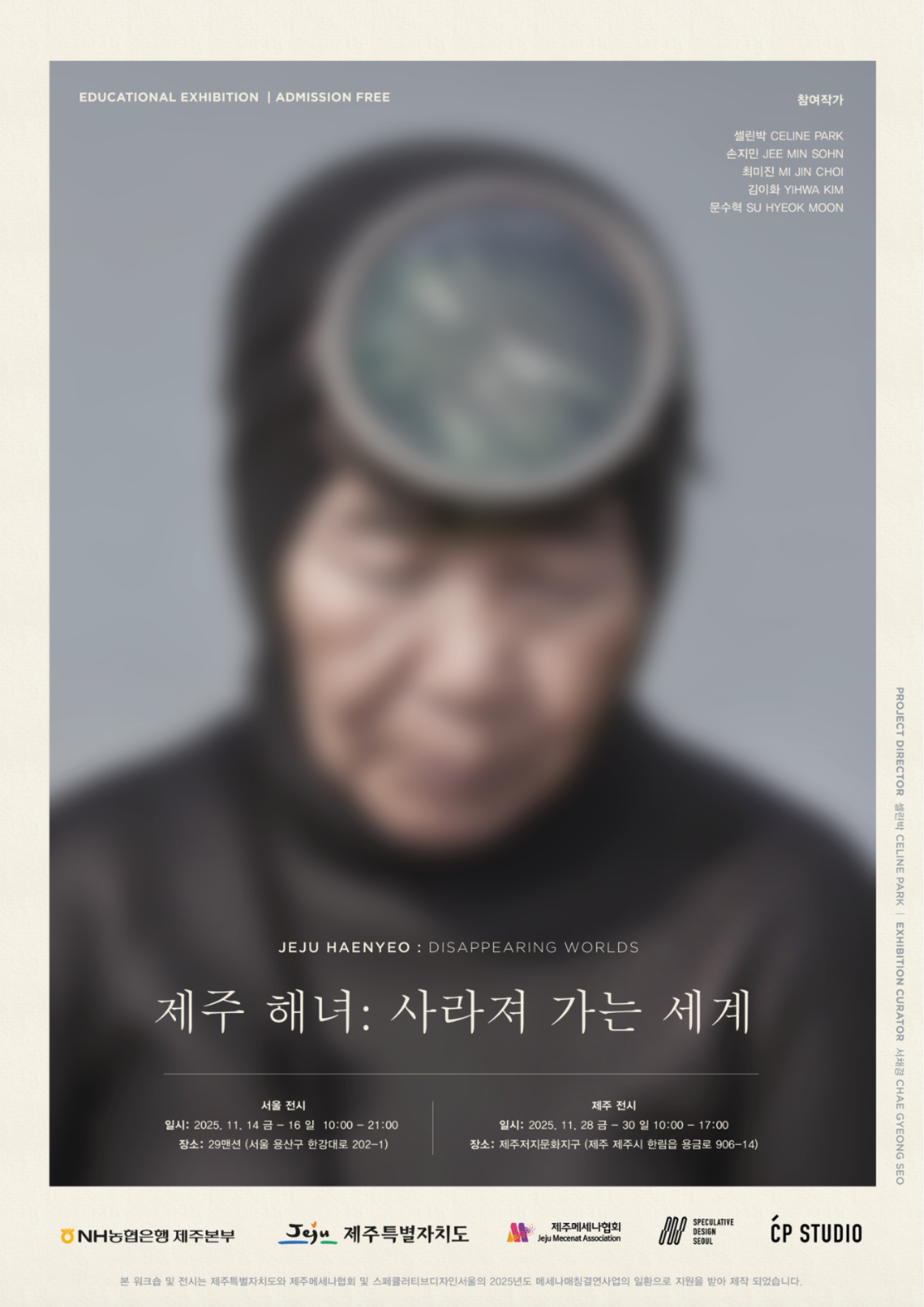
JEJU HAENYEO : DISAPPEARING WORLDS
SDS JEJU HAENYEO WORKSHOP 2025
Céline Park conceived the Jeju Haenyeo Project to enable designers to explore the lives and culture of Jeju’s female divers (Haenyeo) through a humanities-based approach. The project was carried out with four designers selected through an open call, who lived in a Haenyeo village for fifteen days. During this period, they engaged with the community through conversations, interviews, field research, and experimental design practices.
Grounded in the concept of Speculative Design, the workshop aimed to reinterpret the Haenyeo’s ecological knowledge, communal rules, and ritualistic practices into the language of design. Based on their on-site experiences, the participating designers created works across various formats—including objects, films, performances, and installations—reimagining the Haenyeo culture from a future-oriented perspective. The project, developed through field research and experimentation in Jeju, was culminated in exhibitions held in Seoul and Jeju in 2025.
셀린 박(Céline Park)은 제주 해녀들의 삶과 문화, 그리고 그 속에 내재된 문화를 디자이너들이 인문학적 연구를 토대로 탐구하게하기 위해 ‘제주 해녀 프로젝트’을 기획했다. 본 프로젝트는 오픈콜을 통해 선발된 네 명의 디자이너와 함께 진행됐으며, 이들은 보름 동안 제주 해녀 마을에서 생활하며 공동체와의 교류, 인터뷰, 현장 조사, 그리고 실험적 디자인 실습을 수행했다. 워크숍은 스페큘레이티브 디자인(Speculative Design)의 개념을 기반으로, 해녀의 삶에서 드러나는 생태적 지식과 공동체의 규율, 의례적 행위를 디자인 언어로 재해석하는 것을 목표로 했다. 참가 디자이너들은 현장에서 얻은 경험을 바탕으로 오브제, 영상, 퍼포먼스, 설치 등 다양한 형식의 결과물을 제작했으며, 이를 통해 미래적 관점에서 해녀 문화를 다시 상상하고자 했다. 이 프로젝트는 제주 현지에서의 리서치와 실험 과정을 거쳐 2025년 서울과 제주에서 전시로 공개되었다.
Project Director: Céline Park
Exhibition Curator: Chae Gyeong Seo
Selected Designers: Yi Hwa Kim, Su Hyeok Moon, Jee Min Sohn, Mi Jin Choi
Organized by: Speculative Design Seoul
July 1-15, 2025
Céline Park ran the workshop under Speculative Design Seoul. Sohn Jimin, Moon Soohyuk, Mijin Choi, and Ehwa Lee have participated in.
Day 1 & Day 14
Day 1 & Day 14
Haeneyo's house for the crews
Haeneyo's house for the crews
Research site
Research site
Assisting Haenyeo with Their Harvest
Assisting Haenyeo with Their Harvest
Jeju Haenyeo Museum
Day 1-15
Jeju Haenyeo MuseumDay 1-15
Jeju Haenyeo Museum
Day 1-15
Jeju Haenyeo MuseumDay 1-15
Jeju Haenyeo Museum
Day 1-15
Jeju Haenyeo MuseumDay 1-15
Jeju Haenyeo Museum with Curator Kwon
Day 3
Jeju Haenyeo Museum with Curator KwonDay 3
Jeju Shamanic Ritual
Day 4
Jeju Shamanic RitualDay 4
Jeju Haenyeo Museum at the Haeneyo's talk
Day 5
Jeju Haenyeo Museum at the Haeneyo's talkDay 5
Speculative design workshop ran by Celine Park
Day 5
Speculative design workshop ran by Celine ParkDay 5
Assisting Haenyeo with Their Harvest
Day 6
Assisting Haenyeo with Their HarvestDay 6
Haenyeo Wetsuit Repair Shop visit
Day 6
Haenyeo Wetsuit Repair Shop visitDay 6
E-Textile workshop ran by Mijin Choi
E-Textile workshop ran by Mijin Choi
Sound drawing workshop ran by Ehwa Lee
Sound drawing workshop ran by Ehwa Lee
Haenyeo Diving Experience
Haenyeo Diving Experience
Textile workshop ran by Soohyuk Moon
Textile workshop ran by Soohyuk Moon
The Jeju haenyeo welcomed our crew into their home and cooked a meal for us.
The Jeju haenyeo welcomed our crew into their home and cooked a meal for us.
Haeneyo's daily harvest
Haeneyo's daily harvest
World Building Workshop ran by Mijin Sohn
World Building Workshop ran by Mijin Sohn
Haenyeo's Kitchen — A Culinary Theatre Experience
Haenyeo's Kitchen — A Culinary Theatre Experience
Lecture by Seung Joon Song
Lecture by Seung Joon Song
Hadori Haenyeos
Hadori Haenyeos
Haenyeo Tewak-Making Workshop
Day 13
Haenyeo Tewak-Making WorkshopDay 13
EXHIBITIONS
PROJECT RESULTS
JEJU HAENYEO BARBIE, Jee Min Sohn 2025
The labor of Haenyeo, long naturalized as an extension of femininity, has framed sacrifice and care as measures of success. Yet society simultaneously labels such lives as outdated while continuing to romanticize and demand these sacrifices, imposing unequal and unsustainable expectations on women. This project pays homage to the invisible labor and devotion of Haenyeo while exposing the quiet heroism embedded in their daily lives. By adopting the visual language of Barbie, the work critiques how beauty and sacrifice are repackaged as “self-improvement,” revealing the simplification and commodification of Haenyeo history and labor. Despite UNESCO recognition, Haenyeo remain vulnerable to being consumed as symbols of tourism. The project repositions them not as heritage icons, but as living subjects whose lives reflect enduring structures of female labor, care, and social inequality. 여성성의 연장선으로 자연화되어 온 해녀의 노동은 희생과 돌봄을 성공의 기준으로 만들어왔다. 그러나 사회는 이러한 삶을 구시대적이라 규정하면서도 동시에 그 희생을 요구하고 낭만화하며, 여성에게 불공정하고 지속 불가능한 기대를 부과한다. 본 프로젝트는 해녀의 비가시적 노동과 헌신에 대한 오마주이자, 일상 속에 은폐된 영웅성을 드러낸다. 바비의 시각 언어를 차용한 작업은 아름다움과 희생이 ‘자기계발’로 포장되어 재생산되는 구조를 비판하며, 해녀의 이미지가 어떻게 단순화되고 상품화되는지를 드러낸다. 유네스코 등재에도 불구하고 해녀는 여전히 관광의 상징으로 소비되고 있다. 이 작업은 해녀를 문화유산의 아이콘이 아닌, 여성 노동과 생존, 모성의 현실을 드러내는 살아있는 주체로 재위치시키며, 오늘날 여성성을 규정하는 구조적 불평등을 비춘다.
JEJU HAENYEO BARBIE, Jee Min Sohn 2025 The labor of Haenyeo, long naturalized as an extension of femininity, has framed sacrifice and care as measures of success. Yet society simultaneously labels such lives as outdated while continuing to romanticize and demand these sacrifices, imposing unequal and unsustainable expectations on women. This project pays homage to the invisible labor and devotion of Haenyeo while exposing the quiet heroism embedded in their daily lives. By adopting the visual language of Barbie, the work critiques how beauty and sacrifice are repackaged as “self-improvement,” revealing the simplification and commodification of Haenyeo history and labor. Despite UNESCO recognition, Haenyeo remain vulnerable to being consumed as symbols of tourism. The project repositions them not as heritage icons, but as living subjects whose lives reflect enduring structures of female labor, care, and social inequality. 여성성의 연장선으로 자연화되어 온 해녀의 노동은 희생과 돌봄을 성공의 기준으로 만들어왔다. 그러나 사회는 이러한 삶을 구시대적이라 규정하면서도 동시에 그 희생을 요구하고 낭만화하며, 여성에게 불공정하고 지속 불가능한 기대를 부과한다. 본 프로젝트는 해녀의 비가시적 노동과 헌신에 대한 오마주이자, 일상 속에 은폐된 영웅성을 드러낸다. 바비의 시각 언어를 차용한 작업은 아름다움과 희생이 ‘자기계발’로 포장되어 재생산되는 구조를 비판하며, 해녀의 이미지가 어떻게 단순화되고 상품화되는지를 드러낸다. 유네스코 등재에도 불구하고 해녀는 여전히 관광의 상징으로 소비되고 있다. 이 작업은 해녀를 문화유산의 아이콘이 아닌, 여성 노동과 생존, 모성의 현실을 드러내는 살아있는 주체로 재위치시키며, 오늘날 여성성을 규정하는 구조적 불평등을 비춘다.
Intertidal Nomad, 2025 Yi Hwa Kim
As intertidal environments become increasingly unstable, traditional collective harvesting systems of the Haenyeo have collapsed, shifting labor from deep waters to shallow coastal zones. In response, Haenyeo have developed safety-oriented intertidal suits and self-assembled survival equipment. Intertidal Nomad is a mobile survival structure that functions as a resting site, changing space, washing station, and temporary market. Through the transformed labor and bodily practices of Haenyeo, the work explores emerging human–ocean relations in the era of climate crisis. 조간대 환경의 불안정화로 해녀들의 전통적 집단 채집 체계는 붕괴되었고, 노동의 중심은 깊은 바다에서 얕은 연안으로 이동했다. 이에 따라 해녀들은 안전 중심의 조간대복과 새로운 생존 장비를 스스로 구성하기 시작했다. Intertidal Nomad는 휴식 공간, 탈의소, 세척대, 임시 판매대의 기능을 동시에 수행하는 이동형 생존 구조물이다. 이 작업은 변화하는 해녀의 노동과 신체 감각을 통해 기후 위기 시대의 인간–해양 관계를 재사유한다.
Intertidal Nomad, 2025 Yi Hwa Kim As intertidal environments become increasingly unstable, traditional collective harvesting systems of the Haenyeo have collapsed, shifting labor from deep waters to shallow coastal zones. In response, Haenyeo have developed safety-oriented intertidal suits and self-assembled survival equipment. Intertidal Nomad is a mobile survival structure that functions as a resting site, changing space, washing station, and temporary market. Through the transformed labor and bodily practices of Haenyeo, the work explores emerging human–ocean relations in the era of climate crisis. 조간대 환경의 불안정화로 해녀들의 전통적 집단 채집 체계는 붕괴되었고, 노동의 중심은 깊은 바다에서 얕은 연안으로 이동했다. 이에 따라 해녀들은 안전 중심의 조간대복과 새로운 생존 장비를 스스로 구성하기 시작했다. Intertidal Nomad는 휴식 공간, 탈의소, 세척대, 임시 판매대의 기능을 동시에 수행하는 이동형 생존 구조물이다. 이 작업은 변화하는 해녀의 노동과 신체 감각을 통해 기후 위기 시대의 인간–해양 관계를 재사유한다.
바당밭 마당밭, Mijin Choi 2025
This audio map traces the memory structure of the Jeju Hadori Haenyeo community, transmitted through oral tradition rather than written records. Experiences from the sea are shared in the yard and circulated within the community, forming a body of situated knowledge essential to survival. Memories shaped by water color, depth, and currents are passed through speech, gradually composing an unofficial map of the sea. “Madangbal” and “Badangbal” represent two interconnected pathways built upon this flow of memory. On one side, the rhythms of breath and waves unfold; on the other, the collective pulse of people and communal life emerges. In this world, memory functions not as the past, but as a living system of survival and social order. This audio journey begins with the voices of Haenyeo in 2025 and extends toward the imagined voices of a recorder and a child in 2060. It reveals layers of oral memory that persist beyond institutional archives, proposing an experimental archive that reconnects disappearing communal knowledge. 이 오디오 맵은 기록되지 않고 구술로 전승되어 온 제주 하도리 해녀 공동체의 기억 구조를 담는다. 바다에서의 경험은 마당에서 공유되고, 공동체 내부에서만 축적되며 생존을 위한 지식으로 이어진다. 물빛, 수심, 조류에 따라 축적된 기억은 말로 전해지며 바다의 비공식적 지도를 형성한다. ‘마당발’과 ‘바당발’은 이러한 기억의 흐름 위에 구축된 두 개의 경로이다. 한쪽에는 파도와 숨의 리듬이, 다른 한쪽에는 사람과 공동체의 호흡이 교차한다. 이 세계에서 기억은 단순한 과거가 아닌 생존의 기술이자 사회적 규율이다. 본 오디오는 2025년 해녀들의 바당발에서 출발해, 2060년의 기록자와 아이의 목소리로 이어진다. 이는 공식 기록 너머에서 여전히 살아 움직이는 구술의 층위를 드러내며, 사라져가는 공동체 기억을 다시 연결하기 위한 실험적 아카이브이다.
바당밭 마당밭, Mijin Choi 2025This audio map traces the memory structure of the Jeju Hadori Haenyeo community, transmitted through oral tradition rather than written records. Experiences from the sea are shared in the yard and circulated within the community, forming a body of situated knowledge essential to survival. Memories shaped by water color, depth, and currents are passed through speech, gradually composing an unofficial map of the sea. “Madangbal” and “Badangbal” represent two interconnected pathways built upon this flow of memory. On one side, the rhythms of breath and waves unfold; on the other, the collective pulse of people and communal life emerges. In this world, memory functions not as the past, but as a living system of survival and social order. This audio journey begins with the voices of Haenyeo in 2025 and extends toward the imagined voices of a recorder and a child in 2060. It reveals layers of oral memory that persist beyond institutional archives, proposing an experimental archive that reconnects disappearing communal knowledge. 이 오디오 맵은 기록되지 않고 구술로 전승되어 온 제주 하도리 해녀 공동체의 기억 구조를 담는다. 바다에서의 경험은 마당에서 공유되고, 공동체 내부에서만 축적되며 생존을 위한 지식으로 이어진다. 물빛, 수심, 조류에 따라 축적된 기억은 말로 전해지며 바다의 비공식적 지도를 형성한다. ‘마당발’과 ‘바당발’은 이러한 기억의 흐름 위에 구축된 두 개의 경로이다. 한쪽에는 파도와 숨의 리듬이, 다른 한쪽에는 사람과 공동체의 호흡이 교차한다. 이 세계에서 기억은 단순한 과거가 아닌 생존의 기술이자 사회적 규율이다. 본 오디오는 2025년 해녀들의 바당발에서 출발해, 2060년의 기록자와 아이의 목소리로 이어진다. 이는 공식 기록 너머에서 여전히 살아 움직이는 구술의 층위를 드러내며, 사라져가는 공동체 기억을 다시 연결하기 위한 실험적 아카이브이다.
생태 복원 부표(Restoration buoy: EOS) Su Hyeok Moon 2025
Jeju’s sea no longer circulates as an autonomous natural system. As rising temperatures and coastal degradation intensify, Haenyeo labor is increasingly structured around managed ecological restoration. Restoration Buoy: EOS functions as both marker and control hub, regulating cycles of artificial recovery and extraction beneath the surface. When marine life returns, zones temporarily open for harvesting before being closed again for restoration. This reflects a shift from traditional rotational fishing practices toward an operational restoration–extraction system. Nature is no longer “natural” but reorganized into an engineered cycle aligned with commercial circulation. The accompanying video reveals how the image of “Beautiful Jeju” is intertwined with tourism, distribution, and regional economies, while foregrounding the aging labor rhythms of Haenyeo that sustain this system. Positioning the viewer as both consumer and accomplice, the work asks: which forms of sustainability do we support, and what costs and responsibilities are we willing to bear? 제주의 바다는 더 이상 자율적으로 순환하는 자연이 아니다. 수온 상승과 연안 황폐화로 해녀의 생업은 ‘생태 복원’이라는 관리 시스템에 점점 더 의존하도록 구조화되고 있다. Restoration Buoy: EOS는 이 체계의 표지이자 제어 장치로, 수면 위 질서의 기호 아래에서 인위적 복원과 채취의 순환을 조율한다. 해조류와 어패류가 회복되면 구역은 ‘작업 구역’으로 열리고, 이후 다시 ‘복원 구역’으로 닫히며 운영된다. 이는 전통적 금채·허채 관행이 관리 기반의 복원–채취 시스템으로 전환된 장면이다. 자연은 더 이상 자연 그대로 존재하지 않고, 해양 생태는 상품 유통을 전제로 한 인공적 순환 구조로 재편된다. 함께 전시된 영상은 ‘아름다운 제주’라는 이미지가 관광·유통·지역 경제 시스템과 결합해 지속성을 설계하는 과정을 드러내며, 그 사이를 메우는 해녀의 노동과 고령화된 신체의 리듬을 병치한다. 이 작업은 관객을 소비자이자 공모자로 위치시키며 묻는다. 우리는 어떤 장면을 지지하고, 그 지속을 위해 어떤 비용과 책임을 감수할 것인가.
생태 복원 부표(Restoration buoy: EOS) Su Hyeok Moon 2025 Jeju’s sea no longer circulates as an autonomous natural system. As rising temperatures and coastal degradation intensify, Haenyeo labor is increasingly structured around managed ecological restoration. Restoration Buoy: EOS functions as both marker and control hub, regulating cycles of artificial recovery and extraction beneath the surface. When marine life returns, zones temporarily open for harvesting before being closed again for restoration. This reflects a shift from traditional rotational fishing practices toward an operational restoration–extraction system. Nature is no longer “natural” but reorganized into an engineered cycle aligned with commercial circulation. The accompanying video reveals how the image of “Beautiful Jeju” is intertwined with tourism, distribution, and regional economies, while foregrounding the aging labor rhythms of Haenyeo that sustain this system. Positioning the viewer as both consumer and accomplice, the work asks: which forms of sustainability do we support, and what costs and responsibilities are we willing to bear? 제주의 바다는 더 이상 자율적으로 순환하는 자연이 아니다. 수온 상승과 연안 황폐화로 해녀의 생업은 ‘생태 복원’이라는 관리 시스템에 점점 더 의존하도록 구조화되고 있다. Restoration Buoy: EOS는 이 체계의 표지이자 제어 장치로, 수면 위 질서의 기호 아래에서 인위적 복원과 채취의 순환을 조율한다. 해조류와 어패류가 회복되면 구역은 ‘작업 구역’으로 열리고, 이후 다시 ‘복원 구역’으로 닫히며 운영된다. 이는 전통적 금채·허채 관행이 관리 기반의 복원–채취 시스템으로 전환된 장면이다. 자연은 더 이상 자연 그대로 존재하지 않고, 해양 생태는 상품 유통을 전제로 한 인공적 순환 구조로 재편된다. 함께 전시된 영상은 ‘아름다운 제주’라는 이미지가 관광·유통·지역 경제 시스템과 결합해 지속성을 설계하는 과정을 드러내며, 그 사이를 메우는 해녀의 노동과 고령화된 신체의 리듬을 병치한다. 이 작업은 관객을 소비자이자 공모자로 위치시키며 묻는다. 우리는 어떤 장면을 지지하고, 그 지속을 위해 어떤 비용과 책임을 감수할 것인가.
Mare Regula, Céline Park 2025
Mare Regula reconstructs the unwritten “rules of the sea” that have long governed the Haenyeo community beyond formal institutions. Transmitted through oral tradition, embodied practice, and collective memory, these regulations have shaped survival strategies, labor ethics, and social order. Through speculative reinterpretations of informal disciplinary tools and regulatory devices, the work visualizes internal systems of control, mutual surveillance, solidarity, and exclusion. Rather than romanticizing tradition, it critically exposes the self-organized governance structures developed for communal survival. Mare Regula repositions the sea as a social space where rules and power intersect, questioning how disappearing communal regulations might be transformed and reimagined in the present. Mare Regula는 제주 해녀 공동체 내부에 존재해왔지만 공식 기록으로 남지 않은 ‘바다의 규율’을 재구성한다. 이 규율은 법이나 제도가 아닌 구술, 관습, 몸의 기억을 통해 전승되며, 해녀들의 생존, 노동 윤리, 공동체 질서를 조율해왔다. 작품은 해녀 사회에서 사용되던 비공식적 처벌 도구와 규제 장치를 통해, 공동체 내부에서 작동하는 통제와 상호 감시, 연대와 배제의 구조를 가시화한다. 이는 전통을 낭만화하기보다, 공동체가 생존을 위해 구축해온 자율적 규범 체계를 비판적으로 드러내는 시도이다. Mare Regula는 바다를 단순한 자연 환경이 아닌, 규칙과 권력이 교차하는 사회적 공간으로 재위치시키며, 사라져가는 공동체 규율이 오늘날 어떤 형태로 변형·계승될 수 있는지를 질문한다.
Mare Regula, Céline Park 2025Mare Regula reconstructs the unwritten “rules of the sea” that have long governed the Haenyeo community beyond formal institutions. Transmitted through oral tradition, embodied practice, and collective memory, these regulations have shaped survival strategies, labor ethics, and social order. Through speculative reinterpretations of informal disciplinary tools and regulatory devices, the work visualizes internal systems of control, mutual surveillance, solidarity, and exclusion. Rather than romanticizing tradition, it critically exposes the self-organized governance structures developed for communal survival. Mare Regula repositions the sea as a social space where rules and power intersect, questioning how disappearing communal regulations might be transformed and reimagined in the present. Mare Regula는 제주 해녀 공동체 내부에 존재해왔지만 공식 기록으로 남지 않은 ‘바다의 규율’을 재구성한다. 이 규율은 법이나 제도가 아닌 구술, 관습, 몸의 기억을 통해 전승되며, 해녀들의 생존, 노동 윤리, 공동체 질서를 조율해왔다. 작품은 해녀 사회에서 사용되던 비공식적 처벌 도구와 규제 장치를 통해, 공동체 내부에서 작동하는 통제와 상호 감시, 연대와 배제의 구조를 가시화한다. 이는 전통을 낭만화하기보다, 공동체가 생존을 위해 구축해온 자율적 규범 체계를 비판적으로 드러내는 시도이다. Mare Regula는 바다를 단순한 자연 환경이 아닌, 규칙과 권력이 교차하는 사회적 공간으로 재위치시키며, 사라져가는 공동체 규율이 오늘날 어떤 형태로 변형·계승될 수 있는지를 질문한다.
